
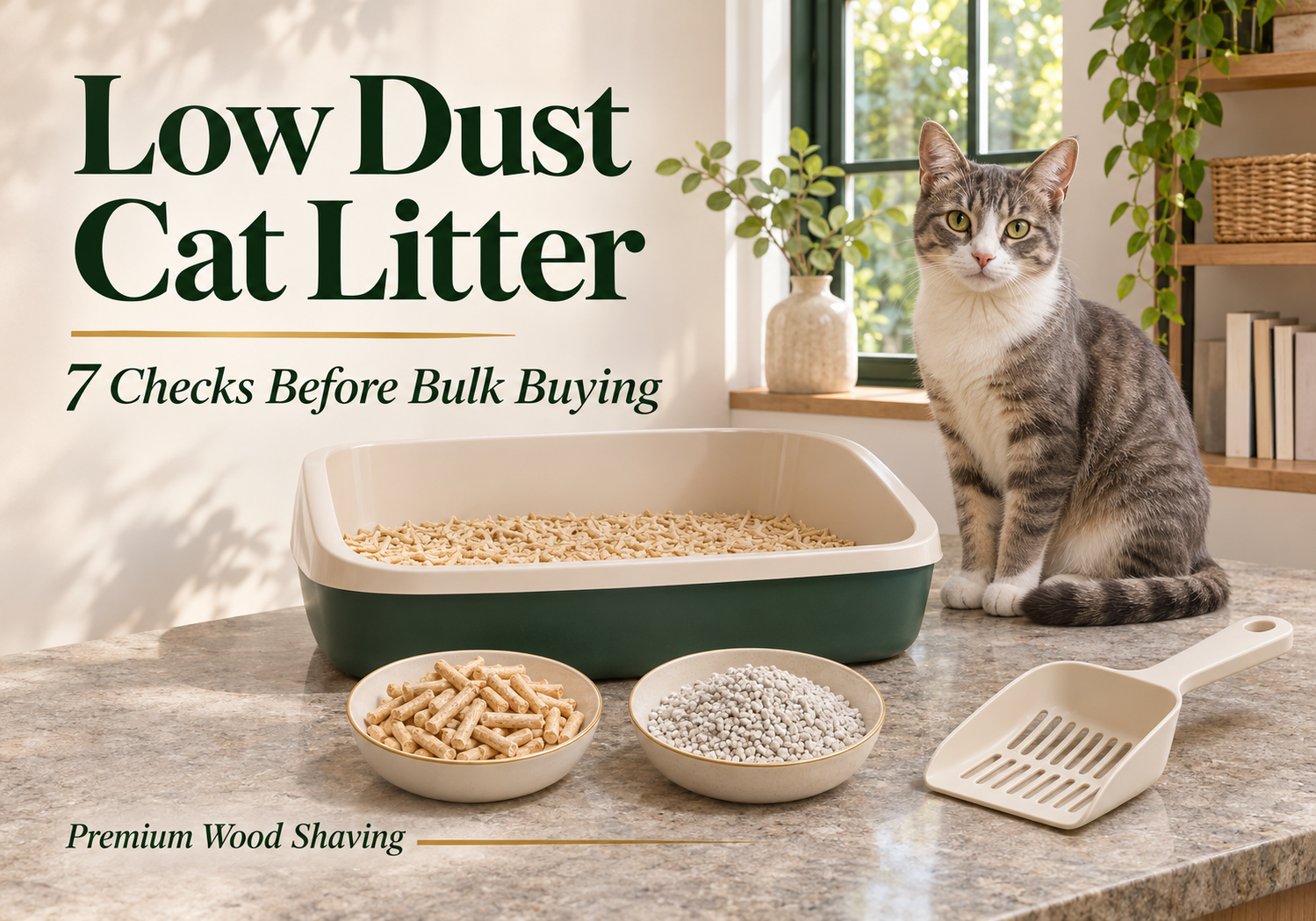
Low dust cat litter should be purchased against a clear specification and a representative sample. For importers and distributors, a label alone does not establish consistent handling performance. Review the dust claim alongside particle condition, cleaning performance, packaging and delivered cost before approving stock for your market.
This guide sets out seven practical buying checks for businesses serving Saudi Arabia, the GCC and other destinations. It separates what a buyer can observe from what requires test evidence, then explains how to turn those findings into a useful quotation request.
In this guide
What low dust cat litter actually tells a buyer
The wording describes a dust-related product attribute, but it does not identify the measurement method by itself. Fine material inside a bag, particle breakdown during handling and visible airborne dust are different observations. Ask what was measured, under which conditions, and whether the result applies to the product being offered.
A meaningful low dust cat litter assessment also covers usability. DLG’s cat litter testing criteria treat dust formation, clump stability, absorption and odour control as separate quality measures. A sample trial can inform purchasing, but it does not establish certification or a laboratory percentage.
7 essential checks for better purchasing value
1. Define the dust claim and its evidence
Ask the supplier to explain the low dust cat litter description. Request available reports, sample identity, test dates and the reporting basis behind any percentage. Compare numerical results only when methods and conditions are compatible. A natural ingredient or premium label does not replace evidence about the finished product.
2. Inspect granules after realistic handling
Review an intact pack representing the intended supply. Check particle consistency, loose fines, broken pellets and seals rather than judging a presentation sample alone. For low dust cat litter orders, ask how the supplier maintains the agreed specification and how sample findings relate to later production or delivered stock.
3. Assess the correct cleaning system
For clumping litter, observe removal, breakage and residue under the stated use instructions. For wood pellets, evaluate the appropriate method of removing used material. Low dust cat litter is not automatically clumping litter. Avoid using a clay-specific trial as the only acceptance test for a different material format.
4. Separate fragrance from odour management
Specify added fragrance independently from dust. Perfume does not demonstrate removal of the source of an odour, and unscented does not prove a particular dust result. When positioning low dust cat litter, give accurate cleaning instructions and scent information. Cats Protection’s litter guidance also highlights individual preferences in texture and fragrance.
5. Record tracking as a separate issue
Tracking concerns litter carried outside the tray, including intact particles. Dust concerns fine material. Record both when reviewing low dust cat litter, together with tray placement and the cleaning setup. Do not turn an observation of reduced airborne material into a promise that no granules will leave the tray.
6. Compare delivered cost and consumption
Include product, transport, handling and other charges within your purchasing responsibility. Compare pack sizes using their stated units and record initial filling separately from top-ups and discarded clean material. A low dust cat litter offer should be assessed on usable supply and operating cost, rather than a low bag price alone.
7. Document the accepted sample and order
Confirm material, pack volume, net and gross weights, packaging and available dust data in the written offer. Agree how the sample represents the proposed supply and how discrepancies will be handled. For low dust cat litter shipments, request the actual packing plan and destination terms before assuming load quantities or delivery costs.
A sample review record buyers can use
| Review field | Record | Avoid assuming |
|---|---|---|
| Dust | Opening, pouring and cleaning observations | That visual checks produce a laboratory percentage |
| Usability | Removal, residue and discarded clean material | That every formulation uses the same routine |
| Tracking | Particles outside the tray and setup | That tracking and dust are identical |
| Economics | Consumption, freight and handling | That litres convert to equal kilograms |
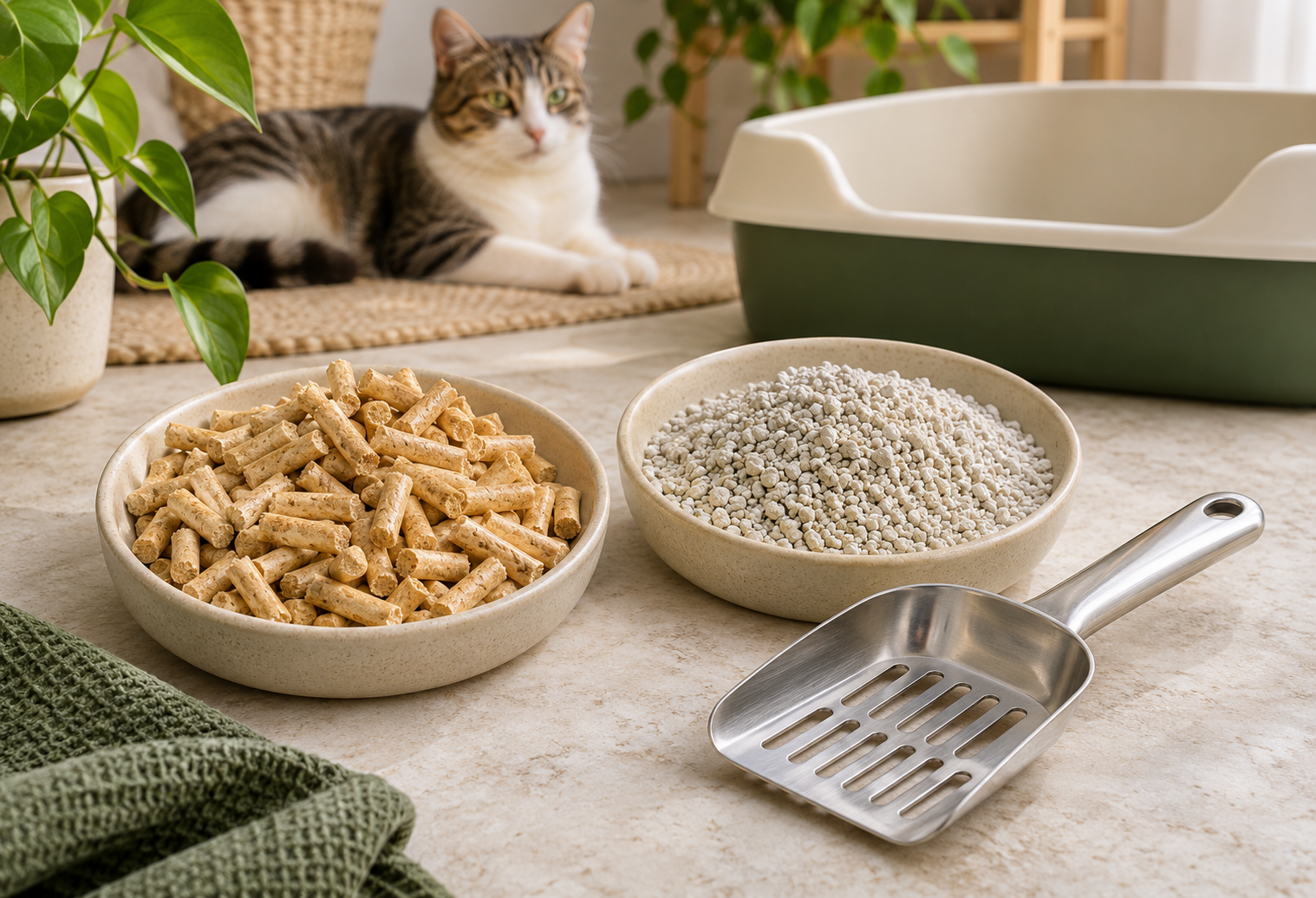
Keep the review conditions consistent where practical and record product instructions and relevant differences. Consumer acceptance matters alongside handling observations. Do not extend a small purchasing trial into a universal health claim, or represent a third-party certificate as evidence for a product it did not assess.
Premium’s published range and a clear enquiry
Premium lists natural pine wood pellet cat litter in 15L packs and white bentonite clumping cat litter in 5L, 10L and 20L options. These published attributes are a starting point for sourcing. Buyers seeking low dust cat litter should request current product-specific information; the pack size or material name does not establish a dust percentage.
Use the wood pellet versus bentonite buying comparison for the material decision, and the scented versus unscented bentonite guide for the fragrance discussion. Keep those decisions separate from the dust evidence required in your purchasing specification.
Request specifications and a wholesale quotation from Premium with the material, pack size, quantity and delivery destination. State the evidence and sample arrangements you need, then confirm availability, packing and commercial terms in writing before approving supply.
Frequently asked buying questions
Does low dust cat litter mean unscented litter?
No. Dust performance concerns fine particles during handling; fragrance concerns added scent. Specify both independently. Neither an unscented label nor a strong perfume establishes a measured dust result for the product.
Are pine pellets always less dusty than bentonite?
No universal ranking applies to every finished product. Compare representative samples, particle condition and the intended cleaning routine. Request product-specific evidence instead of transferring one material’s reputation to an untested supplier or batch.
What supports a 99.9% dust-free claim?
Request the report, sample identity, test method and reporting basis. A powder-content measurement and airborne dust during use need not describe the same result. Do not copy another brand’s percentage into your product listing.
Does a 20L bag weigh 20kg?
No. Litres measure volume; kilograms measure mass. Obtain net and gross weights and pack dimensions for freight and storage planning. There is no fixed conversion suitable for every litter formulation.
What should a wholesale enquiry include?
Specify material, pack size, quantity, destination and the dust evidence you require. Ask about representative samples, current availability, packing and delivery terms. Confirm the accepted specification in writing before approving a bulk order.