
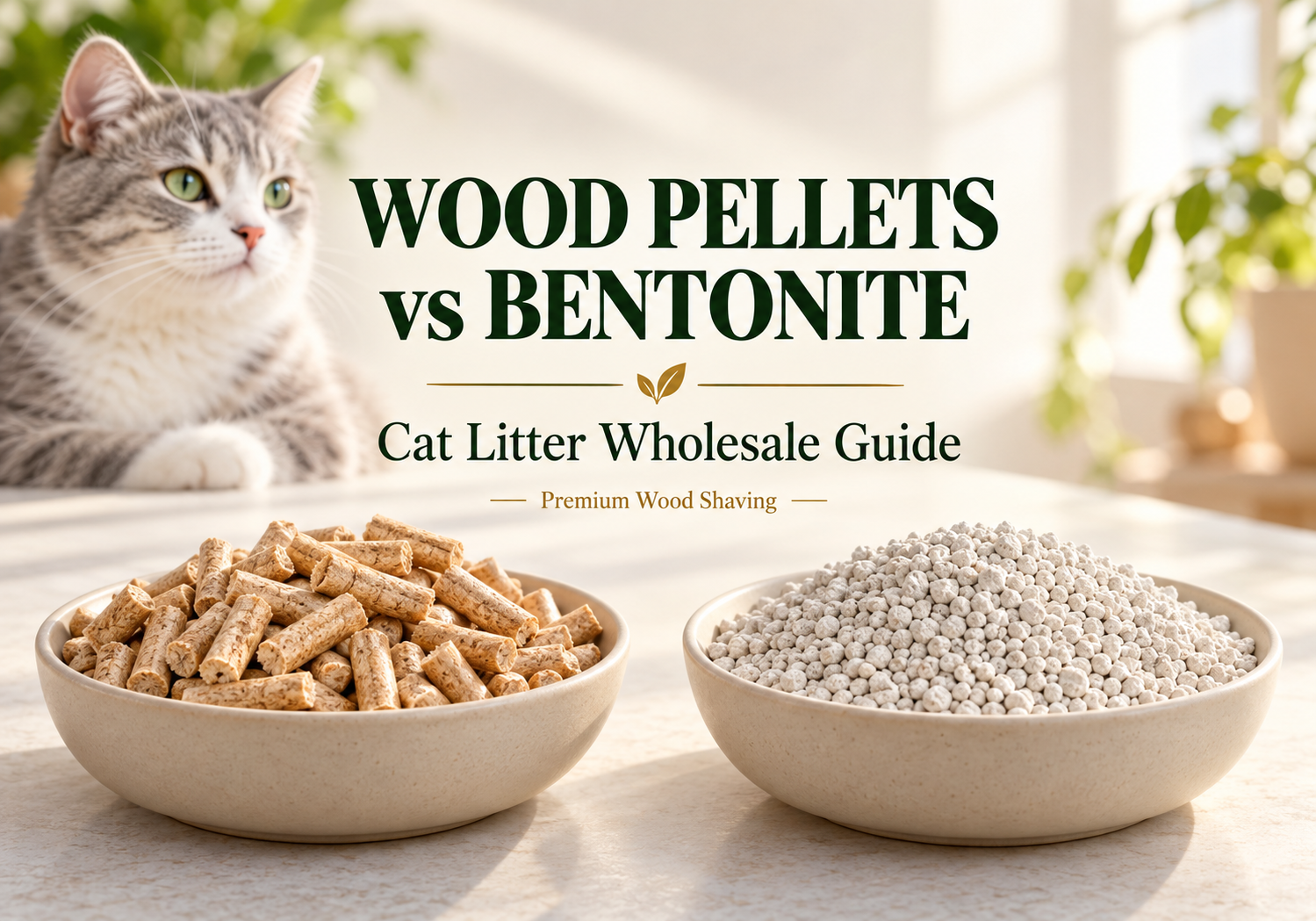
For wholesale buyers comparing wood pellet vs bentonite cat litter, the practical choice is a range decision. Bentonite offers a clumping mineral line; pine pellets offer a distinct wood-based alternative. Select against the customer you serve, sample results and delivered pack economics, rather than assuming one material is universally better.
This guide is for importers, distributors and retail category buyers sourcing for Gulf markets and other destinations. It sets out how to compare products, build a specification and request a quotation that supports a purchasing decision.
Wood pellet vs bentonite cat litter: buying comparison
| Buying criterion | Pine wood pellets | White bentonite |
|---|---|---|
| Material and form | Compressed pine wood pellets | Mineral granules |
| Published Premium packs | 15L | 5L, 10L and 20L |
| Cleaning approach | Remove waste and used material to pack instructions | Scoop waste and formed clumps |
| Clumping status | Do not assume pellets are a clumping formula | Clumping is listed for this product |
| Range role | A separate wood-based choice | A mineral clumping line with multiple sizes |
| Sample priorities | Pellet integrity and wet behaviour | Clump integrity and scoopability |
| Logistics comparison | Actual weight, dimensions and packing plan | Actual weight, dimensions and packing plan |
The pack details above describe Premium’s published products, not a universal specification for every supplier. Review the 15L pine wood pellet cat litter and white bentonite clumping cat litter before fixing the product lines in your enquiry.
Define the retail job before choosing the material
Bentonite for a clearly explained clumping offer
A bentonite line suits a range brief built around scooping formed clumps. Assess whether 5L, 10L or 20L packs match the retailer’s customers and delivery model. Size availability creates assortment options; it does not establish which size will sell fastest in your territory.
Pine pellets for a distinct wood-based line
Pine pellets can broaden a range for customers seeking wood-based litter. Retailers need clear guidance on texture and cleaning because ordinary pellets behave differently from clumping clay. Some wood formulas contain clumping agents, so specify the actual product rather than treating all wood litter as interchangeable.
Compare samples using a written acceptance brief
Ask whether samples represent the proposed production specification. Record the product, batch reference where available, packing condition and storage conditions. For a comparative wet test, keep the liquid quantity, observation interval and test method consistent, then record the outcome instead of turning a small trial into a universal performance claim.
For bentonite, observe how a clump forms and survives scooping. For pine pellets, observe pellet integrity before use and the material’s response after wetting. Regular non-clumping pine pellets can break down as they absorb liquid; do not apply a competitor’s tray instructions to a different formula.
Review dust during pouring and cleaning, fragrance or other additives, and the supplier’s written product data. A material name alone does not prove a dust percentage, absorption ratio or odour-control duration. Confirm any claim that your retailers intend to print on shelf labels or product listings.
Calculate landed cost per saleable pack
Request quotations with a named destination and clearly defined delivery terms. Separate the goods value from packaging, transport and applicable import costs included in the comparison. For Gulf enquiries, identify the receiving port or warehouse; an origin quote and a warehouse-delivered quote cannot be compared as equivalent offers.
Landed cost per saleable pack = total agreed costs to the receiving point ÷ saleable packs received.
Compare price per litre within the same product line and pack specification, but treat cross-material cost per litre as only one input. Litre capacity does not measure weight or prove equal usage life. Add channel fees, fulfilment and other variable selling costs when assessing contribution per pack.
Check packing and shipment inputs before booking
Get net and gross weights, pack dimensions and the proposed outer packing for each SKU. Ask for the actual loading plan before estimating packs per container. Differences in weight, volume and packing can change which transport constraint matters; avoid inserting a standard container quantity into the purchase order without confirmation.
Agree the documents and label information required for your destination with the supplier and your appointed logistics adviser. Keep certification, local stock, private-label availability and exclusivity as questions unless confirmed in the offer. Confirm availability and timing for the order you intend to place.
Plan a pilot range and retailer handover
Discuss a sample or trial order where available, then track sell-through, replenishment requests and cleaning-related questions by product. Retain the agreed sample reference and compare it with incoming goods. Scale the range using those observations rather than a fixed wood-to-bentonite split borrowed from another market.
Give retailers product-specific cleaning and storage instructions. Cats Protection’s litter guidance highlights individual preferences for texture and scent, so avoid promising universal acceptance. RSPCA guidance recommends gradual introduction or a separate tray when changing litter. These points help retailers explain a new material without overstating suitability.
Wholesale sourcing questions
Is wood pellet or bentonite cat litter better for wholesale?
Neither material wins every buying scenario. Bentonite provides a clumping mineral option, while pine pellets add a wood-based line. Choose against customer demand, sample performance, pack economics and the support retailers need.
Does pine wood pellet cat litter clump?
Ordinary pine pellets should not be assumed to clump like bentonite. Some wood-based formulas include a separate clumping agent. Premium lists compressed pine pellets, while its white bentonite product explicitly lists clumping action. Confirm the exact formula and cleaning instructions.
Which type costs less to ship?
Request actual net and gross pack weights, dimensions and a packing plan. A litre is a volume, not a kilogram. Freight efficiency depends on the proposed load, destination and transport terms, so compare written quotations rather than a material-wide claim.
Can buyers source both materials in one order?
Send a line-by-line request with product, pack size, quantity and delivery destination. Premium can review the proposed mix and confirm what is available. Mixed loads, minimum quantities and dispatch timing require confirmation in the quotation.
Is wood pellet cat litter automatically flushable?
No. A wood-based ingredient does not establish flushing suitability or local disposal permission. Follow the product label and local waste guidance; Premium’s published instructions direct buyers to dispose of used litter with waste, not to advertise it as flushable.
Request a quotation for your buying brief
Send Premium your destination, business type, requested quantities and pack sizes for each material, plus the intended receiving point and timing. Request a wood pellet and bentonite wholesale quotation so the comparison covers the products and delivery arrangement your business actually needs.