
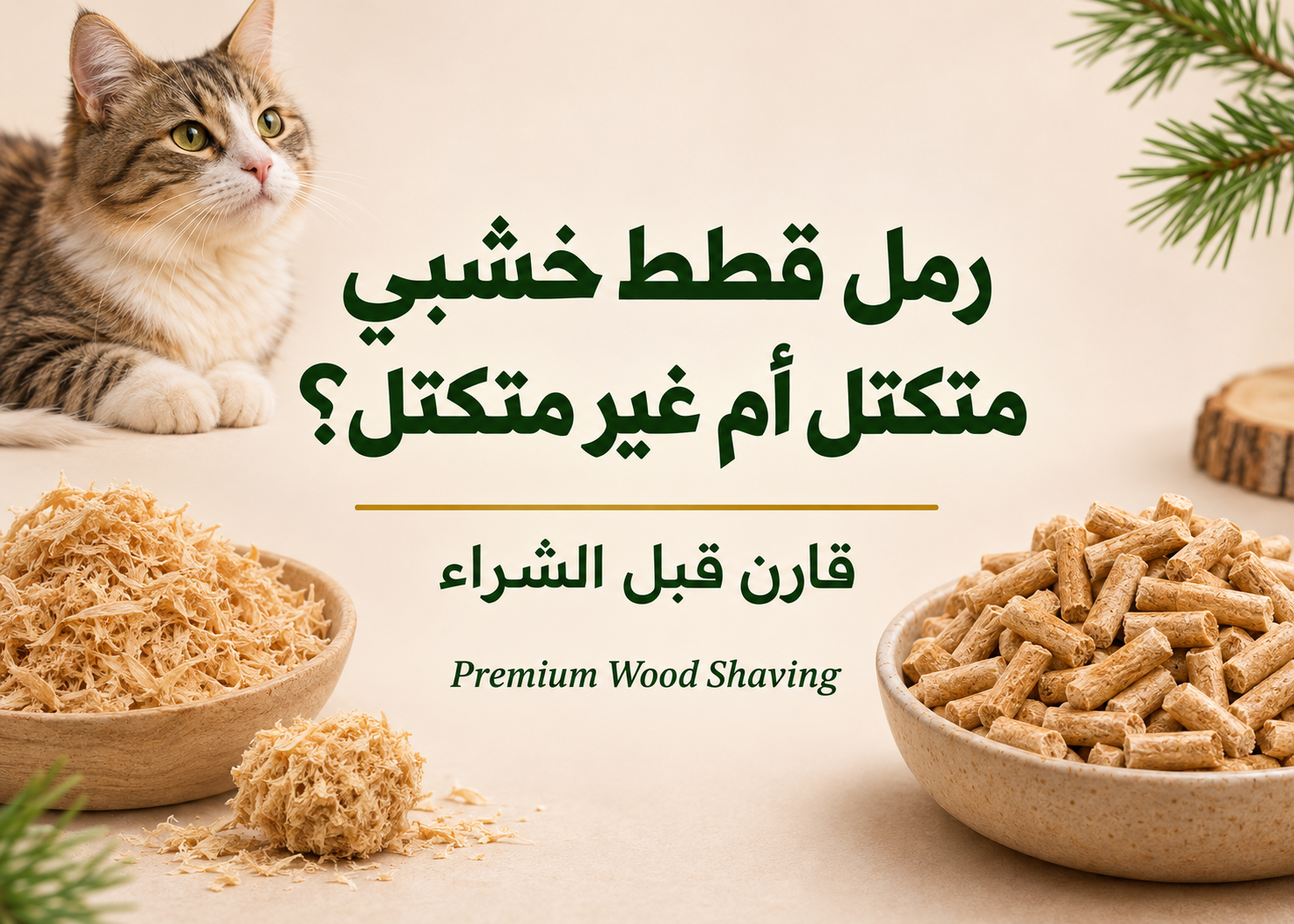
Clumping vs non-clumping wood cat litter is a choice between maintenance systems. A clumping formula forms removable wet masses; a non-clumping product absorbs moisture without providing that same scooping behaviour. Choose against the finished specification, equipment compatibility and customer expectations, rather than treating all pine pellets as interchangeable.
For importers, distributors and retail category buyers supplying Saudi Arabia, the GCC and other markets, a clear distinction prevents inaccurate listings and avoidable complaints. This guide explains what to verify in samples, how to compare delivered value and what Premium’s published pine pellet specification actually confirms.
Clumping vs non-clumping wood litter: procurement comparison
| Purchase field | Clumping wood formula | Non-clumping wood formula |
|---|---|---|
| Wet behaviour | Forms a mass intended for removal | Absorbs liquid; some pellets break into fines |
| Cleaning workflow | Remove clumps and solid waste as instructed | Remove solids and used material as instructed |
| Equipment | Scoop openings must suit granules and clumps | Sifting may suit particular pellet products |
| Physical format | May include granules or clumping pellets | Often compressed pellets; verify the label |
| Evidence required | Clump formation and removal behaviour | Wet breakdown and separation behaviour |
| Commercial assessment | Delivered cost, waste and customer fit | Delivered cost, waste and customer fit |
Do not use pellet shape as a clumping specification
Manufacturers demonstrate why appearance is insufficient. Cat’s Best identifies Smart Pellets as a clumping product, while Feline Pine’s technical FAQ describes a non-clumping pine pellet that breaks into sawdust and a separate clumping formula containing a clumping agent. These are product-specific examples, not a recipe shared by every wood litter supplier.
Write material, physical format and clumping status as separate purchase fields. A label saying natural pine or wood fibre does not answer how the finished product behaves when wetted. Nor does a reference to a binding ingredient establish clump strength without evaluating the proposed formulation.
Match the maintenance system to the retail proposition
A clumping offer needs usable clumps
Assess whether the wetted mass can be removed with the intended scoop and how much clean litter leaves with it. Observe whether fragments remain behind. Filling depth and waiting time should follow that product’s instructions, because transferring another brand’s routine can distort your assessment.
A non-clumping offer needs clear used-material removal
For products that disintegrate after wetting, the maintenance brief should explain how to handle the resulting fines and replenish intact material. A sifting tray may help with a compatible product, but a double tray should not be presented as compulsory for the entire wood category. Check aperture size and the manufacturer’s method.
Retailers should explain this workflow before purchase. A customer moving from clay may expect every wet area to lift out as a firm clump. Accurate instructions reduce that mismatch. If the buyer is choosing between materials rather than maintenance formats, use the wood pellet versus bentonite comparison to address that separate decision.
Evaluate samples against a written acceptance brief
- Record product identity, material, declared clumping status and batch reference where available.
- Inspect the unopened pack, closure and dry material for broken pellets or excessive loose fines.
- Compare equal litter quantities with equal liquid additions and a consistent observation interval.
- Assess clump lifting or used-material separation using the intended scoop or tray.
- Record clean material discarded, residue and the practical maintenance steps.
- Ask whether the sample represents the proposed supply specification and retain the agreed instructions.
A repeatable buyer trial supports purchasing judgement; it does not substantiate a laboratory dust percentage, antibacterial claim or universal health benefit. Request the evidence behind claims you plan to reproduce on packaging or listings. Keep fragrance, dust, particle size and wet behaviour distinct in the specification.
Compare use cost alongside delivered pack economics
A lower bag price does not establish the lower cost of tray care. Record initial filling, top-ups, clean material discarded and full changes under comparable use conditions. Clumping and non-clumping systems can waste material in different ways, particularly when the scoop or tray does not suit the product.
For commercial quotations, compare the same unit and include freight and handling within your purchasing responsibility. Obtain net and gross weights, outer dimensions and the proposed packing plan. A 15L label states volume; it does not establish a 15kg weight, pallet count or container loading capacity.
Include transition and equipment guidance in retailer support
Cats Protection advises gradual litter changes and recognises individual preferences for texture and scent. Keep customer advice practical and avoid portraying a material change as a treatment. An unexpected change in toileting habits warrants veterinary advice rather than repeated product switching.
For automatic litter boxes, check the equipment maker’s approved materials and operating instructions. Clumping status alone does not establish compatibility. Disposal also needs a product-specific instruction: a wood ingredient is not sufficient evidence that used litter can be flushed. Premium’s published directions tell users to bag used material for disposal under local guidance.
What Premium’s 15L pine pellet specification confirms
Premium’s pine wood pellet cat litter is published as natural pine wood in compressed pellet form, supplied in a 15L pack. The page does not explicitly declare clumping status. Request written confirmation of wet behaviour, maintenance and the proposed supply specification before approving a product category or retail description.
Request a quotation against the specification you need
Send the required number of 15L packs, delivery destination, intended sales channel and the maintenance format your customers expect. Ask about current availability, sample arrangements, packaging, minimum quantity and expected preparation time. Treat these as quotation questions rather than assuming a standard offer.
Contact Premium for a wood litter wholesale quotation and request confirmation of the exact product description to appear on your order. If you require a specifically clumping formula, state it clearly so the team can confirm suitability and availability before you commit to a purchase.
Frequently asked questions
Does all wood cat litter clump?
No. Wood identifies the material, while clumping describes wet behaviour. Wood litters include clumping and non-clumping formulations, and pellet shape alone does not establish the category. Confirm the written specification and assess a representative sample.
Are all cylindrical wood pellets non-clumping?
No. Some manufacturers sell clumping mini-pellets. Conventional non-clumping pine pellets may break down after absorbing liquid, but that behaviour should not be assigned to every pellet-shaped product. Use the exact product declaration and cleaning instructions.
Which wood litter needs a sifting tray?
A suitable sifting system can help separate fines from intact pellets in some non-clumping products. It is not a universal requirement for wood litter. Check the product instructions and opening size, and verify equipment compatibility before recommending a tray.
Does Premium’s pine pellet litter have confirmed clumping action?
Premium publishes natural pine wood, compressed pellets and a 15L pack. Its product page does not explicitly confirm clumping status. Request written confirmation of wet behaviour and maintenance instructions before approving a clumping or non-clumping listing.
Can buyers treat 15 litres as 15 kilograms?
No. Litres measure volume and kilograms measure mass. Request actual net and gross weights, pack dimensions and the proposed packing plan. Compare freight and storage using the confirmed figures rather than assuming a fixed conversion for all wood-based litter.