
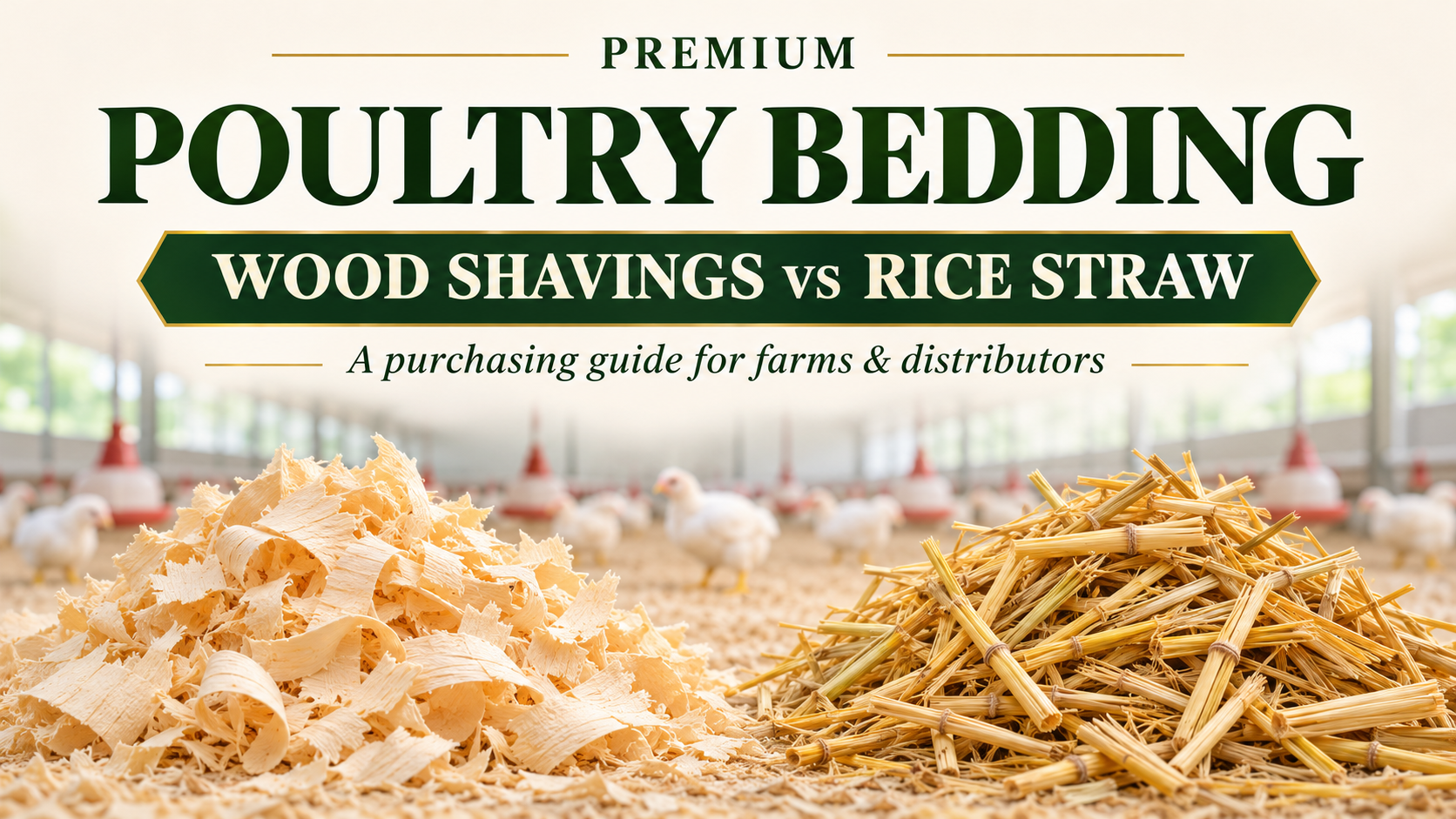
Poultry bedding should be compared as prepared materials used under a defined farm routine. Wood shavings offer a practical option when you need an identifiable bedding product and consistent packing. Rice straw deserves consideration when a suitable clean, dry and prepared supply is available at a workable total cost.
For farm procurement teams and distributors serving Saudi Arabia and the Gulf, the purchase decision extends beyond the price per tonne. Include preparation, delivery, replenishment and handling in the comparison, then evaluate the actual material offered.
Buyer takeaway: compare the delivered specification, farm management requirements and recorded operating cost. Choose a tested material that suits the facility; do not rely on an advertised saving or a universal performance claim.
In this comparison
What materials are being compared as Poultry Bedding?
Wood shavings are flakes prepared for bedding use. Rice straw is the stalk material left after harvesting rice. Rice hulls are the grain’s outer covering after processing and are a different material; evidence about hulls cannot automatically be applied to straw.
State the exact material and preparation in a sourcing enquiry. Check whether the offered rice straw is ready for spreading or needs additional cutting and handling. An unprepared agricultural residue and a packaged bedding product do not represent equivalent purchasing scopes.
Poultry Bedding: 7 purchasing checks
| Buying check | Wood shavings | Rice straw |
|---|---|---|
| Material identity | Bedding flakes; specify wood source | Prepared rice stalk material |
| Preparation | Check flake size and fines | Check cutting and piece consistency |
| Wet behaviour | Monitor drying and caking | Monitor drying and matting |
| Batch condition | Inspect contamination and storage | Inspect contamination and storage |
| Quantity | Use net weight and consumption | Use net weight and consumption |
| Operating cost | Delivery, top-ups and work | Delivery, preparation, top-ups and work |
| Supply approval | Sample, specification and availability | Sample, specification and availability |
1. Identify the material and source
Specify the bedding application, raw material and preparation. Inspect a representative batch sample for foreign objects and unsuitable fragments. A pale colour or agricultural origin is not a complete quality test. The purchasing record should identify the poultry bedding actually offered, making later deliveries easier to compare.
2. Include preparation in the specification
Shavings vary in flake size and fine particles, while straw needs attention to cutting and consistent piece length. Cooperative Extension guidance on chopped straw explains that preparation influences matting and management. Compare ready-to-use materials, or separately price the extra work required before straw can enter the house.
3. Evaluate moisture and caking in use
Observe wet patches, surface condition and how the material is managed. University of Georgia guidance on litter quality discusses bedding characteristics and moisture control. Water leakage, ventilation and operating routines also matter. Changing poultry bedding should not be treated as a substitute for addressing those conditions.
4. Check batch condition and fine particles
Examine packing, evidence of wetting, unusual odour and visible contamination. Observe the sample during spreading and request measurement information where it forms part of the buying specification. Do not assume that all shavings are dust-free or that every straw batch has equivalent quality because the material name matches.
5. Compare handling and required quantities
Record net weight, package dimensions, unloading requirements and storage capacity. Compression describes packing rather than a guaranteed area of coverage. Estimate poultry bedding needs from relevant consumption records or a suitable trial, separating the initial placement from replenishment. Confirm the actual net pack weight used in the calculation.
6. Measure total operating cost
Include material, delivery, any cutting or preparation, replenishment and labour costs that apply. A cheaper straw quotation may cover a different preparation stage; a higher shavings price does not by itself establish poorer value. Compare the same operating area and period, with the assumptions visible to the purchasing team.
7. Agree the repeat-supply reference
Discuss available quantities, specification consistency, preparation time and the receiving process. Distributors supplying several farms need clear product descriptions for customer orders. Keep purchasing records to review repeat poultry bedding deliveries against the agreed specification.
Trial the materials before a larger Poultry Bedding order
Plan a suitable comparison with the farm’s technical lead. Record the material, initial quantity, operating area, top-ups and work required. Keep conditions comparable where practical and document meaningful differences. Monitor the surface and wet areas without attributing every change in the house to the bedding alone.
A published comparison of alternative litter materials included wood shavings and rice straw among several treatments. A particular trial does not establish a universal result for a current product or every production system. Evaluate the preparation and batch you intend to buy.
Compare recorded costs over the same area and period, and identify differences in flock conditions or management. Keep poultry bedding decisions within the facility’s care programme. The outcome should be a repeatable specification and an informed cost comparison.
Source pine Poultry Bedding from Premium
Premium lists pine poultry wood shavings in 20 kg and 25 kg bales. Send the intended application, required quantity and destination to confirm the offered specification and packing. The comparison with rice straw does not establish a rice-straw product in Premium’s listed range.
As a weight example, one net tonne equals 40 bales at 25 kg or 50 bales at 20 kg. These conversions do not predict a fixed coverage area. For a shipment quotation, confirm bale dimensions and the actual loading plan rather than estimating a container quantity from bale weight alone.
Poultry Bedding questions from buyers
Is wood shavings or rice straw better for poultry bedding?
The decision depends on batch quality, preparation, farm management and operating cost. Compare representative materials under relevant conditions rather than applying a fixed winner to every farm.
Are rice straw and rice hulls the same?
No. Rice straw is harvested stalk material, while rice hulls are the grain’s outer covering. Name the exact material in the specification and do not interchange performance evidence.
Does rice straw need preparation?
Check cutting, piece consistency, cleanliness and suitability before use. If extra preparation is required, include that work in the cost comparison with ready-to-use shavings.
Will changing poultry bedding prevent caking?
No material guarantees that result alone. Preparation, water, ventilation and the management routine also affect litter condition. Evaluate the material within the farm’s established care programme.
Which poultry bale weights does Premium list?
Premium lists pine poultry bedding in 20 kg and 25 kg bales. Confirm available specification, packing, quantity and supply arrangements in the quotation.
Request a Poultry Bedding supply quotation
Use Premium’s B2B order request to send the product, quantity, delivery point and target receiving date. Email sales@premiumwoodshaving-eg.com for sourcing enquiries, or contact the team for general questions. Ask for the material description, packing and included costs alongside the poultry bedding price.